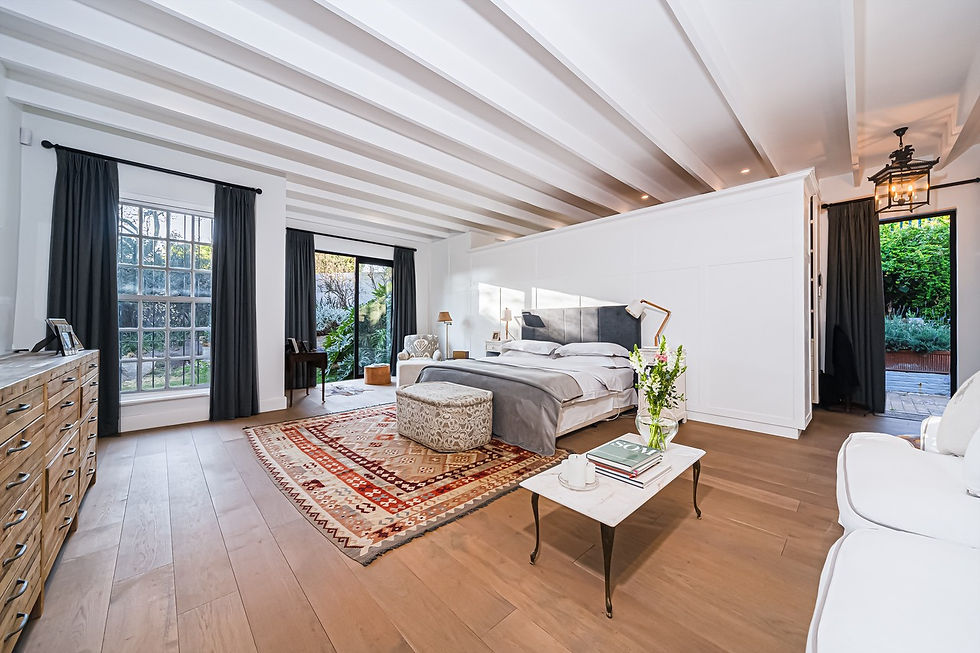
Mixing Antiques in Modern Interior Design
Almost every South African family has one. A yellowwood kist that came down from a grandmother, a ball-and-claw dining table too big for any room in the house, a riempie chair with the seat gone soft. It lives in a spare room or a garage because nobody can quite bring themselves to sell it and nobody can quite see where it could go.

The answer is nearly always to bring it in. Mixing antiques in modern interior design is one of the surest ways to give a new home the depth that otherwise takes decades to arrive, and it is far less complicated than most people fear.
What One Old Thing Does to a Room
A house furnished all at once has a particular flatness to it. Everything is the same age, the same finish, the same idea of good taste, and it reads as a showroom rather than a home. Bring in one piece with eighty or a hundred years on it and the whole scheme relaxes. The eye has somewhere to land. The room stops looking as though it was decided in an afternoon.
On top of this, an inherited piece carries a story, and stories are the one thing you cannot order in. A client’s grandfather’s writing desk in a modern study will always be more interesting than an excellent reproduction of one.
Keep the Piece You Actually Love
Not everything old is worth keeping, and sentiment can slowly fill a house with furniture nobody enjoys. When we go through a client's inherited pieces with them, we are asking a few plain questions.
Do you like looking at it? The best reason to keep something is that it gives you pleasure every time you walk past.
Is the shape good? Proportion and line survive changes in taste. A well-made stinkwood chair from the 1890s still has a better silhouette than most of what is sold new today.
Can it work hard? A kist that becomes a coffee table or a linen store earns its keep twice over. A piece that can only be looked at needs to be very good indeed.
Is it in reasonable health? Loose joints, woodborer and perished webbing are all fixable. Get a quote before you commit, so the piece doesn’t become a project you resent.
Give It Room to Breathe
The most common mistake is crowding. An antique surrounded by other antiques disappears into a general brownness and nobody sees any of it. Put the same object among plain, contemporary furniture and it becomes the thing you notice as you walk in.
One hero per room is a sound rule. Keep the walls quiet, keep the upholstery around it simple, and give the old piece the kind of space a gallery would give a painting. In a Johannesburg home with good light, that can be as simple as placing it where the afternoon sun reaches across it and shows up the grain.
Make the Join Look Deliberate
What separates an eclectic room from a confused one is usually a thread running through it. Three that work reliably:
Colour: Pick up a tone from the old piece somewhere else in the room. The warm red-brown of stinkwood repeated in a cushion, a rug or a ceramic is enough to make the pairing look intentional.
Material: Brass on an old handle and brass on a new light fitting will find each other across a room without any help from you.
Line: A curved antique wants some curve elsewhere, whether that is a round mirror or a soft-edged armchair. Contrast in age is interesting. Contrast in absolutely everything is noise.
Scale is worth watching as well. A heavy Cape dresser in a room of low, light furniture can look marooned. Give it a companion with some visual weight, a large artwork or a substantial lamp, and it settles straight away.
Restore It, or Leave It Alone?
Patina is worth far more than most people think. The soft, uneven sheen on a hundred-year-old table is the record of a century of use. Strip it and re-lacquer it and you remove the character along with, very often, a good part of the value.
Our rule of thumb is to repair the structure and respect the surface. Re-glue joints, treat woodborer, replace failing webbing and tired springs. Reupholster freely, because fabric is the one part meant to be renewed, and a modern linen on an old frame is the quickest way to pull a piece into the present. Think hard before sanding anything back, and if you suspect the piece is truly valuable, speak to a restorer before you touch it.
Where to Find Them
Family first. Ask the question before things get sold off or given away, because the pieces with a story attached are the ones you will keep longest.
Beyond that, South Africa is unusually well supplied. Buy the best example you can afford of one thing rather than three mediocre ones, and be willing to wait for it.
The Point of It
A home that mixes eras looks like it belongs to someone in particular, versus a generic inhabitant. Give the old piece a proper place, keep what surrounds it calm, and it will do more for the room than anything you could order new.