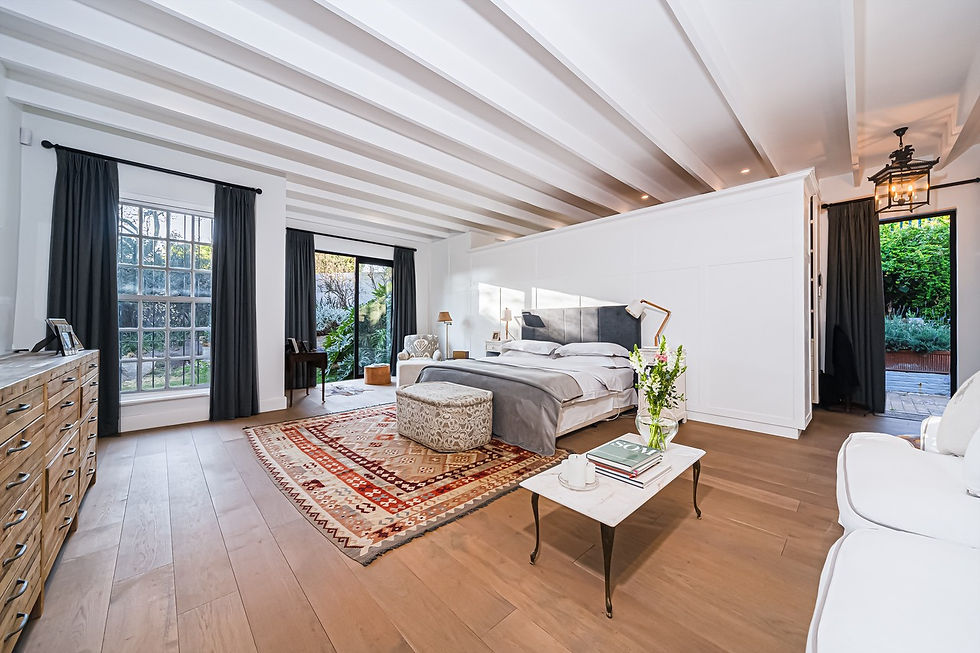
Designing for Natural Light in South African Homes
Anyone who has spent a winter morning in Johannesburg knows the particular quality of our light. It arrives clean and almost startlingly bright, casting long, sharp shadows across a floor before softening into something gentler by mid-afternoon. It is one of the great privileges of designing homes in this country, and one of the more interesting challenges.

Natural light in South African homes is not a decorative afterthought. It is the medium through which every other choice in a room is experienced. A colour that looks warm and enveloping in a London showroom can turn chalky and cold under a Highveld sun. A finish that reads as softly reflective in one home can become a source of glare in another.
Understanding Natural Light in South African Homes
South Africa sits at a latitude and an altitude that give us light of unusual clarity. Johannesburg, at roughly 1,750 metres above sea level, receives light with less atmospheric filtering than most cities. The result is a brightness that is genuinely different in character from the softer, more diffused light of northern Europe.
This has practical consequences. Our winter light comes in low and long, reaching deep into north-facing rooms and warming them beautifully. Our summer light is high, intense, and directly overhead by midday, which is why the same room can feel entirely different in December than it does in June.
Before making a single material decision, spend time in the room across a full day. Note where the light falls at eight in the morning, at noon, at four in the afternoon. This is the most useful design brief you will ever write.
How Light Changes Colour
This is where many otherwise well-planned schemes come undone. Paint colours, fabrics, and stone all shift depending on the direction and intensity of the light falling on them.
North-facing rooms receive the most consistent, generous light throughout the day; the opposite of what applies in the northern hemisphere. These spaces can carry cooler, more restrained tones beautifully, as the abundant light prevents them from feeling austere.
South-facing rooms receive indirect, cooler light. Here, warmer undertones (soft clay, muted ochre, warm greige) will compensate and prevent a space from feeling flat or grey.
East-facing rooms are flooded with light in the morning and quieter by afternoon, which makes them natural candidates for bedrooms and breakfast spaces.
West-facing rooms catch the golden warmth of late afternoon, though they can also carry considerable heat. Deeper, richer colours hold their own here without being bleached out.
Whatever the orientation, always test paint on a large sample board and move it around the room over several days. Two coats, matte finish, viewed at different hours. It is a small amount of patience that saves a great deal of regret.
Window Treatments That Work With the Light, Not Against It
There is a temptation to think of curtains and blinds as a way of controlling light, when in truth their most valuable role is to shape it.
Sheer linen or voile: The most versatile choice for our climate. It diffuses harsh midday light into something soft and enveloping, while preserving the sense of openness that makes a room feel generous.
Timber shutters: Particularly suited to west-facing rooms, where adjustable louvres let you angle light upward toward the ceiling rather than directly into the room.
Full-height hanging: Hang curtains close to the ceiling and let them fall to just above the floor. It draws the eye upward and makes windows appear larger than they are; a small trick with an outsized effect.
What to avoid: heavy, dark treatments that swallow light in rooms that already receive very little of it. If a space is naturally dim, the answer is rarely to add more weight.
Reflective Surfaces and the Art of Bouncing Light
Once light enters a room, the surfaces within it determine how far it travels and how it feels when it arrives.
Mirrors remain the most effective tool available. Positioned opposite or adjacent to a window, a well-placed mirror will double the perceived light in a space and extend the sense of depth. A large antiqued mirror above a fireplace, or a full-height panel in a narrow passage, does a great deal of quiet work.
Beyond mirrors, consider the finish of your surfaces. Honed marble and polished plaster catch and hold light with a soft luminosity that high-gloss finishes cannot match (gloss tends to reflect light sharply, creating hotspots and glare under our strong sun). Pale timber floors, satin-finished cabinetry, and glazed ceramic tiles all lift a room without overwhelming it.
Metal deserves a mention here too. Brass and bronze accents (a lamp base, a cabinet handle, the frame of a mirror) catch the light and warm it as they reflect it. Used sparingly, they add a glow that no paint colour can replicate.
A Few Principles Worth Holding On To
Design for the light you have, not the light you wish you had. A dim room can be beautiful, but it should be designed as a dim room, with depth and intimacy, rather than fought.
Keep sightlines to windows open. Avoid placing tall furniture where it blocks the path of light into the room.
Paint ceilings in a soft white or a shade lighter than the walls. The ceiling is your largest reflective surface and it works hardest when it is allowed to.
Let light and texture work together. The interplay between a shaft of afternoon sun and a rough plaster wall, or a woven rug, is one of the most beautiful things a room can offer.
Light as the First Design Decision
The homes that feel most alive are almost always the ones where light has been considered from the very beginning: not treated as something that happens to a room, but as something the room has been shaped around.
It is also, thankfully, one of the few elements of a home that costs nothing to work with. It simply asks to be noticed.
If you’re thinking about how to make the most of the light in your own home, we’d be glad to talk it through with you. Get in touch with SWD today.